Last Updated: October 22, 2026
Quick Summary
Benefits of a CLU Living TV Cabinet include superior cable management, effective equipment ventilation, and acoustically transparent doors that allow remote signals to pass through unobstructed. These engineered entertainment centres solve everyday problems like tangled cables, overheating equipment, and cluttered living spaces while enhancing your room's aesthetic.
- Quality TV cabinets feature dedicated cable management pathways and rear access panels for full visibility and reach to every connection point
- Flow-through ventilation and adjustable shelving prevent equipment overheating and extend component lifespan significantly
- Acoustically transparent doors allow remote control signals and speaker sound to pass through without opening the cabinet
- Cabinet prices range from about $2,500 for compact models to $5,000 and above for tall, wide units in premium timber
- A well-built cabinet typically lasts over a decade, lowering its effective annual cost compared with replacing budget units multiple times
Table of Contents
Why a CLU Living TV Cabinet Transforms Your Media Setup
The benefits of a CLU Living TV cabinet go far beyond holding your television. These engineered entertainment centres solve everyday problems: tangled cables, overheating equipment, remotes that won't work through closed doors, and furniture that looks cluttered no matter how you organise it.
A quality TV cabinet designed with genuine audio-visual expertise works harder than standard media furniture, and the difference shows immediately in how your living room functions and looks.
At CLU Living, the best cabinets combine three qualities: thoughtful design that handles the technical side of home theatre, durability through years of use, and aesthetics that enhance your space rather than dominate it.
Key TakeawayA well-designed TV cabinet handles cable management, equipment ventilation, and remote access simultaneously, three things most furniture simply ignores.
How to Choose a TV Cabinet That Fits Your Space
Start with your actual requirements, beginning with television size.
Measure your available width and depth carefully, and account for ventilation clearance: most quality cabinets require at least 100mm of space above and behind for airflow.
Consider your media components. Soundbars, gaming consoles, streaming boxes, and amplifiers all need accessible placement, and adjustable shelving lets you reconfigure as your setup evolves.
Think about your room's layout and traffic patterns. A cabinet in a high-traffic area benefits from hidden wheels; if your setup is permanent, stability and integrated levellers matter more.
Pro TipMeasure your doorways, hallways, and final placement location before ordering. A cabinet that's technically in stock can still be impossible to deliver if it won't physically fit through your home's access points.
CLU Living TV Stand Cable Management: Keeping Your Setup Organised
Cable chaos is the most visible problem with standard media furniture: wires tangle, connections loosen, and the back of your cabinet looks like something nobody should see.
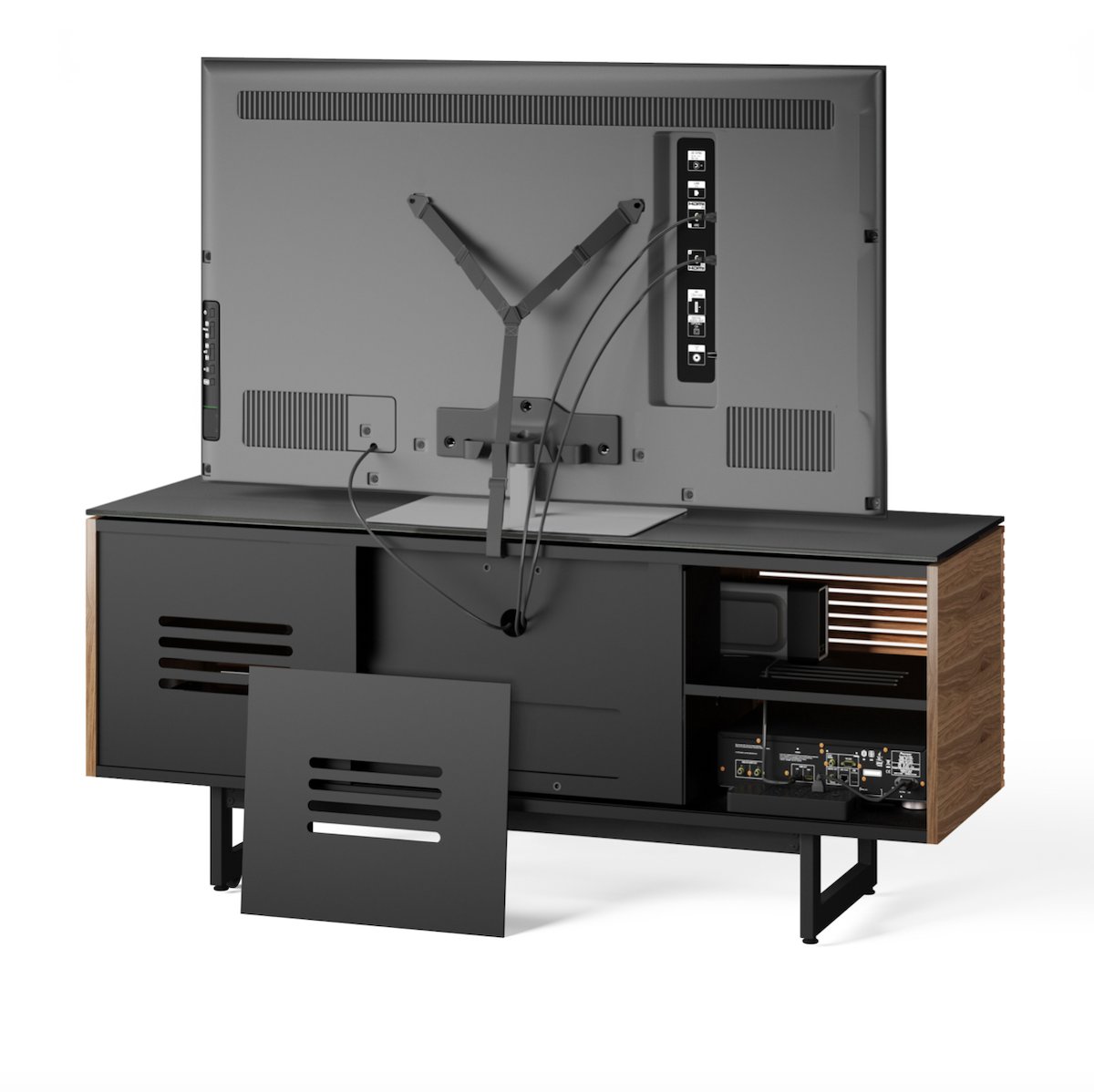
Quality TV cabinets include dedicated cable management pathways built into their structure, routing cables through channels that keep them separated, accessible, and out of sight.
The best cabinets feature rear access panels that open completely, giving full visibility and reach to every connection point.
Acoustically transparent doors are another critical feature. They allow remote control signals and speaker sound to pass through unobstructed, so you don't need to open doors to adjust volume or change inputs.
Media Cabinet Ventilation and Equipment Protection
Electronics generate heat, and trapped heat shortens equipment lifespan significantly. A cabinet that looks beautiful but doesn't breathe damages your components every time you use it.
Effective ventilation requires thoughtful design. Flow-through ventilation, where air can move freely from front to back, works far better than simple vent holes.
Removable back panels serve double duty: they improve ventilation by removing a barrier to airflow and give you access to connections without dismantling anything.
Interior layout affects ventilation too.
TV Cabinet Size Guide: Matching Your Television and Space
Television sizes are measured diagonally, but what matters for furniture selection is the actual width of the television with its stand or wall mount, plus the weight the cabinet top must carry.
For a television requiring a cabinet width of around 1,600-1,700mm, the Align 7477ME Entertainment Cabinet in Ebonised Ash at $4,595.00 is designed for this size range at 1,670mm wide.
Align 7477ME Entertainment Cabinet | Ebonised Ash
For larger setups, a television needing cabinet width of approximately 2,000-2,100mm can be accommodated. The Corridor 8179 Tall Entertainment Cabinet in Natural Walnut at $4,965.00 accommodates large screens and measures 2,010mm wide.
Corridor 8179 Tall Entertainment Cabinet | Natural Walnut →
Corridor 8179 Tall Entertainment Cabinet | Natural Walnut
The Profile 8479 Entertainment Cabinet in Washed Oak at $4,820.00 sits between these options, with a width of 2,080mm but a lower profile of 600mm.
Profile 8479 Entertainment Cabinet | Washed Oak
Depth matters equally. Most quality cabinets are 460-510mm deep. This depth accommodates modern AV components comfortably while fitting into typical living room layouts.
Fit checks before you buy
Work through these measurements in order, because a cabinet that fails any one of them will not work regardless of how good it looks:
-
Television footprint and weight. Confirm the cabinet top is wider than your TV's overall width and rated for its weight. A cabinet narrower than the screen looks unbalanced and can be top-heavy.
-
Soundbar placement. A soundbar 900-1,200mm wide needs either a top surface deep enough to seat it in front of the TV foot or a dedicated shelf. Check that the soundbar does not obscure the screen's bottom edge or block the cabinet's ventilation slots.
-
Component clearances. Measure each device's height and add 25-50mm above it. Amplifiers and receivers run hottest and need the most headroom; games consoles need front-to-back airflow as well as top clearance.
-
Outlet and aerial access. Confirm a power point and aerial or network connection sit within reach of the cabinet's rear access. If the nearest outlet is more than about 1.5m away, plan for an extension lead or a longer cable run before delivery.
-
Room and access measurements. Measure the final wall width, the doorway the cabinet must pass through, and any hallway turns. A cabinet that is technically in stock can still be impossible to deliver if it will not physically fit through your home's access points.
Watch OutA cabinet that's too small for your television creates visual imbalance and leaves you without adequate storage. A cabinet that's too large overwhelms the room and wastes interior space. The right size should leave roughly equal visual weight on either side of your screen.
Design, Durability and Long-Term Value
The materials and construction methods used in a TV cabinet determine how long it lasts, how it ages visually, and what it costs to own over time.
Quality cabinets use solid timber combined with veneered panels: solid timber on visible edges and structural components where strength matters, veneered panels for stable, flat surfaces that resist warping.
Timber selection affects both appearance and longevity. Natural walnut develops character over time, with subtle colour shifts that many people find appealing. Ebonised ash provides a contemporary black finish that hides dust and marks well.
Soft-close doors and drawers extend cabinet lifespan by preventing the slamming that gradually loosens hinges and joints. Infinity adjustment hinges let doors open to any angle and stay there, which matters when accessing equipment inside.
What drives the price
Cabinet prices in this category generally run from about $2,500 for a compact two-door model to $5,000 and above for a tall, wide unit in a premium timber. The main price factors are:
-
Width and configuration. Wider cabinets with more bays and drawers use more material and hardware.
-
Timber and finish. Solid-timber edges and premium veneers cost more than painted or laminate surfaces.
-
Hardware. Soft-close runners, adjustable hinges and integrated levellers add cost but reduce long-term wear.
-
Mobility features. Hidden wheels and levelling systems are engineered additions, not standard fittings.
Warranty, assembly and delivery
A three-year warranty on workmanship and materials covers defects in construction and materials but typically not accident or misuse damage. Read the terms before purchase and keep your receipt, because claims usually require proof of purchase and may exclude natural timber movement or finish wear.
Confirm before ordering whether the unit is delivered assembled or flat-packed, who handles assembly, and whether delivery includes placement in the room and packaging removal. Disclose your access details at the point of sale, since upstairs rooms or narrow access points can attract a surcharge.
Trade-offs to weigh
-
Footprint and weight. A wide, tall cabinet offers the most storage but occupies more floor space and is heavier to move, even on hidden wheels.
-
Finish care. Timber veneers need more careful cleaning than laminate and can mark if liquids are left standing.
-
Cable access. Rear panels that open fully improve access but add cost and complexity compared with fixed backs.
-
Cost versus lifespan. A cabinet at the upper end of the range typically lasts well beyond a decade, which lowers its effective annual cost compared with replacing a cheaper unit every few years.
Hidden wheels on cabinets like the Corridor 8179 let you reposition your setup without dragging furniture across the floor, which matters in rentals or when experimenting with layouts. Integrated levellers ensure stability once you've found the right position.
Key TakeawayJudge a cabinet on total cost of ownership: purchase price plus delivery and assembly, divided by expected years of service, with warranty cover as the safety net. On that basis, a well-built cabinet in a durable timber finish usually costs less per year than a budget unit replaced twice.
Making the Right Choice for Your Home
Selecting a TV cabinet is about matching your specific situation to a product designed for it; a cabinet perfect for one home might be wrong for another, even if they look similar.
List your non-negotiables: television size, room space constraints, components to store, and the aesthetic direction you want. If you're uncertain how a cabinet will work in your space, our Interior Designer service can help you visualise the fit and explore how different options suit your room's layout and style.
The benefits of a CLU Living TV cabinet show up in daily use. Your remote works reliably through closed doors. Your equipment stays cool and lasts longer. Your cables stay organised instead of becoming a tangle. Your living room looks intentional and curated rather than cluttered.
At CLU Living, our curated selection includes cabinets engineered for genuine home theatre performance, and we're here to help you find the piece that fits your space, needs, and vision.
The right TV cabinet does more than hold your television: it organises your media setup, protects your equipment, and creates the visual foundation for your living room. CLU Living's curated collection of quality media cabinets balances sophisticated design with genuine functionality. Choose options and discover how the right cabinet transforms your media experience.
Frequently Asked Questions
What are the main benefits of a BDI TV cabinet?
A BDI TV cabinet offers multiple advantages for your media setup. Built-in cable management keeps wires organised and hidden, while flow-through ventilation protects your equipment from overheating. Adjustable shelves adapt to different component sizes, and acoustically transparent doors allow remote signals to pass through unobstructed. The thoughtful design combines storage capacity with modern aesthetics, making it ideal for both compact spaces and larger rooms. Quality construction and a three-year warranty ensure your investment lasts.
How do I choose the right TV cabinet size for my space?
Start by measuring your television width and checking the recommended TV size for each model. The Align 7477ME suits TVs up to 70 inches and fits compact spaces at 1670mm wide, whilst the Corridor 8179 and Profile 8479 accommodate TVs up to 85 inches and are wider at approximately 2010mm and 2080mm respectively. Consider your room layout, viewing distance, and available wall space. Measure your alcove or wall carefully to ensure the cabinet depth (typically 460–510mm) fits your setup. If your space is unusual or you're uncertain, we can help confirm compatibility before purchase.
Do BDI TV cabinets really help with cable management?
Yes, cable management is a core feature of BDI cabinets. Each model includes dedicated cable management areas and rear access panels that allow you to route wires neatly behind the unit. Hidden wheels enable you to move the cabinet forward to access rear connections without disconnecting everything. This design keeps your setup tidy, reduces tangled cables, and makes future upgrades or maintenance much easier. The combination of these features addresses one of the most frustrating aspects of home theatre setup.
Why is ventilation important in a media cabinet?
Media equipment generates heat during use. Without proper airflow, components can overheat, reducing their lifespan and performance. BDI cabinets feature flow-through ventilation and louvered doors that allow heat to dissipate safely. This keeps your amplifiers, receivers, and other AV components at safe operating temperatures. The ventilation design also works with acoustically transparent doors, so you don't sacrifice airflow for sound quality or aesthetics. Proper ventilation is especially important if you use your media setup regularly or in a compact space where heat buildup is a concern.




Benefits of a BDI USA TV Cabinet for Modern Homes
Last Updated: October 22, 2026
Quick Summary
Benefits of a CLU Living TV Cabinet include superior cable management, effective equipment ventilation, and acoustically transparent doors that allow remote signals to pass through unobstructed. These engineered entertainment centres solve everyday problems like tangled cables, overheating equipment, and cluttered living spaces while enhancing your room's aesthetic.
Table of Contents
Why a CLU Living TV Cabinet Transforms Your Media Setup
The benefits of a CLU Living TV cabinet go far beyond holding your television. These engineered entertainment centres solve everyday problems: tangled cables, overheating equipment, remotes that won't work through closed doors, and furniture that looks cluttered no matter how you organise it.
A quality TV cabinet designed with genuine audio-visual expertise works harder than standard media furniture, and the difference shows immediately in how your living room functions and looks.
At CLU Living, the best cabinets combine three qualities: thoughtful design that handles the technical side of home theatre, durability through years of use, and aesthetics that enhance your space rather than dominate it.
How to Choose a TV Cabinet That Fits Your Space
Start with your actual requirements, beginning with television size.
Measure your available width and depth carefully, and account for ventilation clearance: most quality cabinets require at least 100mm of space above and behind for airflow.
Consider your media components. Soundbars, gaming consoles, streaming boxes, and amplifiers all need accessible placement, and adjustable shelving lets you reconfigure as your setup evolves.
Think about your room's layout and traffic patterns. A cabinet in a high-traffic area benefits from hidden wheels; if your setup is permanent, stability and integrated levellers matter more.
CLU Living TV Stand Cable Management: Keeping Your Setup Organised
Cable chaos is the most visible problem with standard media furniture: wires tangle, connections loosen, and the back of your cabinet looks like something nobody should see.
Quality TV cabinets include dedicated cable management pathways built into their structure, routing cables through channels that keep them separated, accessible, and out of sight.
The best cabinets feature rear access panels that open completely, giving full visibility and reach to every connection point.
Acoustically transparent doors are another critical feature. They allow remote control signals and speaker sound to pass through unobstructed, so you don't need to open doors to adjust volume or change inputs.
Media Cabinet Ventilation and Equipment Protection
Electronics generate heat, and trapped heat shortens equipment lifespan significantly. A cabinet that looks beautiful but doesn't breathe damages your components every time you use it.
Effective ventilation requires thoughtful design. Flow-through ventilation, where air can move freely from front to back, works far better than simple vent holes.
Removable back panels serve double duty: they improve ventilation by removing a barrier to airflow and give you access to connections without dismantling anything.
Interior layout affects ventilation too.
TV Cabinet Size Guide: Matching Your Television and Space
Television sizes are measured diagonally, but what matters for furniture selection is the actual width of the television with its stand or wall mount, plus the weight the cabinet top must carry.
For a television requiring a cabinet width of around 1,600-1,700mm, the Align 7477ME Entertainment Cabinet in Ebonised Ash at $4,595.00 is designed for this size range at 1,670mm wide.
Align 7477ME Entertainment Cabinet | Ebonised Ash
For larger setups, a television needing cabinet width of approximately 2,000-2,100mm can be accommodated. The Corridor 8179 Tall Entertainment Cabinet in Natural Walnut at $4,965.00 accommodates large screens and measures 2,010mm wide.
Corridor 8179 Tall Entertainment Cabinet | Natural Walnut →
Corridor 8179 Tall Entertainment Cabinet | Natural Walnut
The Profile 8479 Entertainment Cabinet in Washed Oak at $4,820.00 sits between these options, with a width of 2,080mm but a lower profile of 600mm.
Profile 8479 Entertainment Cabinet | Washed Oak
Depth matters equally. Most quality cabinets are 460-510mm deep. This depth accommodates modern AV components comfortably while fitting into typical living room layouts.
Fit checks before you buy
Work through these measurements in order, because a cabinet that fails any one of them will not work regardless of how good it looks:
Design, Durability and Long-Term Value
The materials and construction methods used in a TV cabinet determine how long it lasts, how it ages visually, and what it costs to own over time.
Quality cabinets use solid timber combined with veneered panels: solid timber on visible edges and structural components where strength matters, veneered panels for stable, flat surfaces that resist warping.
Timber selection affects both appearance and longevity. Natural walnut develops character over time, with subtle colour shifts that many people find appealing. Ebonised ash provides a contemporary black finish that hides dust and marks well.
Soft-close doors and drawers extend cabinet lifespan by preventing the slamming that gradually loosens hinges and joints. Infinity adjustment hinges let doors open to any angle and stay there, which matters when accessing equipment inside.
What drives the price
Cabinet prices in this category generally run from about $2,500 for a compact two-door model to $5,000 and above for a tall, wide unit in a premium timber. The main price factors are:
Warranty, assembly and delivery
A three-year warranty on workmanship and materials covers defects in construction and materials but typically not accident or misuse damage. Read the terms before purchase and keep your receipt, because claims usually require proof of purchase and may exclude natural timber movement or finish wear.
Confirm before ordering whether the unit is delivered assembled or flat-packed, who handles assembly, and whether delivery includes placement in the room and packaging removal. Disclose your access details at the point of sale, since upstairs rooms or narrow access points can attract a surcharge.
Trade-offs to weigh
Hidden wheels on cabinets like the Corridor 8179 let you reposition your setup without dragging furniture across the floor, which matters in rentals or when experimenting with layouts. Integrated levellers ensure stability once you've found the right position.
Making the Right Choice for Your Home
Selecting a TV cabinet is about matching your specific situation to a product designed for it; a cabinet perfect for one home might be wrong for another, even if they look similar.
List your non-negotiables: television size, room space constraints, components to store, and the aesthetic direction you want. If you're uncertain how a cabinet will work in your space, our Interior Designer service can help you visualise the fit and explore how different options suit your room's layout and style.
The benefits of a CLU Living TV cabinet show up in daily use. Your remote works reliably through closed doors. Your equipment stays cool and lasts longer. Your cables stay organised instead of becoming a tangle. Your living room looks intentional and curated rather than cluttered.
At CLU Living, our curated selection includes cabinets engineered for genuine home theatre performance, and we're here to help you find the piece that fits your space, needs, and vision.
The right TV cabinet does more than hold your television: it organises your media setup, protects your equipment, and creates the visual foundation for your living room. CLU Living's curated collection of quality media cabinets balances sophisticated design with genuine functionality. Choose options and discover how the right cabinet transforms your media experience.
Frequently Asked Questions
What are the main benefits of a BDI TV cabinet?
A BDI TV cabinet offers multiple advantages for your media setup. Built-in cable management keeps wires organised and hidden, while flow-through ventilation protects your equipment from overheating. Adjustable shelves adapt to different component sizes, and acoustically transparent doors allow remote signals to pass through unobstructed. The thoughtful design combines storage capacity with modern aesthetics, making it ideal for both compact spaces and larger rooms. Quality construction and a three-year warranty ensure your investment lasts.
How do I choose the right TV cabinet size for my space?
Start by measuring your television width and checking the recommended TV size for each model. The Align 7477ME suits TVs up to 70 inches and fits compact spaces at 1670mm wide, whilst the Corridor 8179 and Profile 8479 accommodate TVs up to 85 inches and are wider at approximately 2010mm and 2080mm respectively. Consider your room layout, viewing distance, and available wall space. Measure your alcove or wall carefully to ensure the cabinet depth (typically 460–510mm) fits your setup. If your space is unusual or you're uncertain, we can help confirm compatibility before purchase.
Do BDI TV cabinets really help with cable management?
Yes, cable management is a core feature of BDI cabinets. Each model includes dedicated cable management areas and rear access panels that allow you to route wires neatly behind the unit. Hidden wheels enable you to move the cabinet forward to access rear connections without disconnecting everything. This design keeps your setup tidy, reduces tangled cables, and makes future upgrades or maintenance much easier. The combination of these features addresses one of the most frustrating aspects of home theatre setup.
Why is ventilation important in a media cabinet?
Media equipment generates heat during use. Without proper airflow, components can overheat, reducing their lifespan and performance. BDI cabinets feature flow-through ventilation and louvered doors that allow heat to dissipate safely. This keeps your amplifiers, receivers, and other AV components at safe operating temperatures. The ventilation design also works with acoustically transparent doors, so you don't sacrifice airflow for sound quality or aesthetics. Proper ventilation is especially important if you use your media setup regularly or in a compact space where heat buildup is a concern.